Types of tv drama: comedy, sit-com, docu-dramas, costume drama, teenage, crime, science fiction, hospital.
Examples of tv dramas/series are: Prison Break, Viva La Bam, Lost, Ghost Whisperer, Skins, The Inbetweeners, 8 Simple Rules, Two and a Half Men, Scrubs and Ugly Betty.
http://www.tv.com/
http://www.whatsontv.co.uk/
http://www.seesaw.com/

Saturday, 9 October 2010

Friday, 8 October 2010
In groups, we had to do a presentation on a specific director on Prezi. This software is difficult and confusing to use at first, but proved to be fun and managable once you had gotten used to it. We did our presentation on Wes Anderson and had to note down things about the other directors, from when they presented theirs.
Shynola
I like Spike Jonze because his style is different and individual and he is able to aim different things which he has directed at various audiences in a smart way. Jackass is stereotypically aimed at boys, but I like it a lot. Where the Wild Things Are could be said to be aimed only at children, but I actually think it has a very wide audience and I enjoy how he was able to do this.
My least favourite of these would most likely be Shynola as I think he's creative, but I don't enjoy how he has made the videos and I don't think his attempt to make a wider audience listen to bands like Blur and Coldplay was that original. The videos just contradict the music itself and I don't think he made the music seem any less "boring" to someone who doesn't already enjoy their music.
Shynola
- His work is artistic.
- He regularly uses animation.
- Directs a lot of Coldplay, Blur, Lambchop and Radiohead music videos.
- Bold colours were used in these videos to widen the target audience and make the music appear less dull. The music videos were in contrast with the music, as these bands are more relaxed.
- His audience is "mass", middle aged and wealthy.
- Hammer and Tongs is Garth Jennings and Nick Goldsmith.
- They directed Vampire Weekend's music video "A Punk."
- Use a variety of different colours.
- The music videos they direct are generally aimed at teens.
- Directed "Son of Rambow," which is aimed at a British audience.
- Michel Gondry is a French man born in May, 1963.
- He has directed music videos for Kanye West, Paul McCartney, Daft Punk and Mia Doi Todd.
- Uses bold colours and has an artistic style.
- Directs The White Stripes' music videos and the Smirnoff commercial.
- Some of his films were criticised for being odd- Science of Sleep wasn't shown everywhere.
- Directed Eternal Sunshine of the Spotless Mind.
- His audience is mainly artistic, open-minded, imaginative people.
- He was born in Rockville, Maryland.
- Directed Being John Malkovich, Jackass and Where The Wild Things Are.
- Jackass is stereotypically aimed at teenage boys.
- Directed a Gap advert which was wild, different and showed how things were to soon "change" at Gap.
- Directed Beastie Boys "Sabotage" music video.
- Born in Netherlands in 1955.
- Filmed videos for Nirvana, Metallica and Depeche Mode.
- Very popular photographer- photographed U2.
- Admires Joy Division and directed a film about their late singer Ian Curtis called Control, which was his first feature film.
- Main focus is broken families.
- Wrote Bottle Rocket, Rushmore and The Royal Tenenbaums with Owen Wilson.
- He has been friends with Owen Wilson since they met at the University of Texas.
- Is a film director, screenwriter, actor and producer of short films and advertisements.
- Uses mainly class British rock in his soundtracks.
- Born in Texas, 1969.
- Directed The Royal Tenenbaums and Fantastic Mr Fox.
- Frequently casts Owen Wilson, Luke Wilson, Jason Schwartzman, Andrew Wilson, Bill Murray, Kumar Pallana, Dipak Pallana, Brian Tenenbaum, Stephen Dignan and Anjelica Huston in his movies.
I like Spike Jonze because his style is different and individual and he is able to aim different things which he has directed at various audiences in a smart way. Jackass is stereotypically aimed at boys, but I like it a lot. Where the Wild Things Are could be said to be aimed only at children, but I actually think it has a very wide audience and I enjoy how he was able to do this.
My least favourite of these would most likely be Shynola as I think he's creative, but I don't enjoy how he has made the videos and I don't think his attempt to make a wider audience listen to bands like Blur and Coldplay was that original. The videos just contradict the music itself and I don't think he made the music seem any less "boring" to someone who doesn't already enjoy their music.
Thursday, 30 September 2010
Film Editing
Last lesson we had to go on the macs to edit the film for the continuity exercise which we filmed during a previous lesson. I thought that it would be quite difficult to learn how to use the software, but it was easy to get used to; although quite frustrating, at times, to cut out the correct part so it would flow properly. When we were actually editing it was simple and you could see the continuity. With some help, we managed to use audio and made it look like an actual movie clip, which was fun and looked more skillful that I thought it would. I enjoyed this task, even though at times it was frustrating, but it was overall fun to play around with and set your mind to.
Wednesday, 29 September 2010


Tuesday, 28 September 2010
Pre- Production Magazine
In the lesson we were asked to design a magazine cover and contents page to do with anything related to the school. We had A3 paper to design it on, in detail. To do this, we needed to think creatively of a title for our magazines but it had to link it to the school, so I chose "Time To Pretend" as my magazine would be about drama, media and music so the title is well suited for those subjects; simple but creative. For ideas for our magazine covers, we looked at other popular magazine covers which had the same sort of style as those we were thinking of. I looked at NME, Spin and Kerrang magazine, for colours and layout. Here is an example of an NME magazine:

We had to think carefully of what colours and fonts to use as we could only choose a maximum of three colours and three fonts to add onto the cover, including the title. We needed to be careful especially with the fonts used, as they needed to be clear, bold and stand out, so I tried not to have any soft edges, as that would give off a different vibe. The three colours I chose were green, blue and black. When designing it on the paper, I found it hard as I wasn't sure what font I was going to do, and until I had the picture ready, I didn't know which colours would be appropriate to use to suit the model and context of the magazine. We needed to draw a picture on the front for detail, but I thought it was difficult as there was no way of being sure which pose the model would use until we actually took the pictures.
Wednesday, 15 September 2010
Hot Fuzz Introduction
From the introduction of Hot Fuzz, you straight away are shown that Nicholas is a policeman in London, so you can infer that he is powerful and well off. He is shown to receive medals, showing that he is courageous, strong, brave and extremely good at his job- so others may be jealous of him. Usually Police officers are together as a force but he is seemingly a competitive individual.
There seems to be a "halo" of gold light around him and he is always framed in the centre-showing his class, status and importance. His forceful march shows that he is very serious about his job and their is an air of stern authority about him.
The name "Nicholas Angel" links to his personality as the short name for "Nicholas" is "Nick" as you can get taken to the "nick". But there is also a connotation of Saint- relating to Saint Nicholas. The word "angel" also of course relates to perfection.
A low angle shot is used often in the introduction to signify his power. There is a fast paced montage to show that he is always on duty, suspecting people and always moving on. Arrogance and lack of emotion is insinuated with the editing used. The music playing throughout is "Goody Two Shoes" by Adam and the Ants-implying the repetitive nature of his job.
There seems to be a "halo" of gold light around him and he is always framed in the centre-showing his class, status and importance. His forceful march shows that he is very serious about his job and their is an air of stern authority about him.
The name "Nicholas Angel" links to his personality as the short name for "Nicholas" is "Nick" as you can get taken to the "nick". But there is also a connotation of Saint- relating to Saint Nicholas. The word "angel" also of course relates to perfection.
A low angle shot is used often in the introduction to signify his power. There is a fast paced montage to show that he is always on duty, suspecting people and always moving on. Arrogance and lack of emotion is insinuated with the editing used. The music playing throughout is "Goody Two Shoes" by Adam and the Ants-implying the repetitive nature of his job.
5 C's
Camera angles
Some of the camera angles used to tell the story are:

This is used to show some of the character's surroundings, interaction and their body language. When you're having a conversation, this would be the part of the person that you could see, so is seen as a "comfortable" shot.
An example of a long shot is:
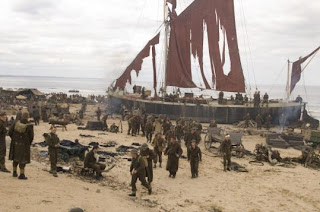
This is generally used to show the audience the setting of the film, providing them with extra information.
Continuity
Continuity refers to when there are visual errors. This is when things happen such as, a character is wearing Converse one moment, and then Vans the next.
Cutting (aka editing)
If it wasn't for this, films would be never ending, as they would be in real-life time. Because of editing, directors are able to change location when they need to. It is used to quicken or slow down the pace of a film.
Close-ups
Close-ups are when a character or object is closely framed. They are mainly used to make the audience focus on the character's facial expressions or an object's detail, but they are used for many reasons in television and film. Along with mid-shots and long-shots, this is the most regular shot used.
Composition
Composition is how props, characters and setting is placed and arranged to how they are needed to be.
Montage
A montage is when a long period of time is cut down so time passes quicker.
Here is an example of a montage, from one of my favourite films Stand By Me:
Some of the camera angles used to tell the story are:
- Close up
- Extreme close up
- Panoramic
- Mid-shot
- Long-shot
- Low angle shot
- Over the shoulder shot
- Point of view shot
- High angle

This is used to show some of the character's surroundings, interaction and their body language. When you're having a conversation, this would be the part of the person that you could see, so is seen as a "comfortable" shot.
An example of a long shot is:

This is generally used to show the audience the setting of the film, providing them with extra information.
Continuity
Continuity refers to when there are visual errors. This is when things happen such as, a character is wearing Converse one moment, and then Vans the next.
Cutting (aka editing)
If it wasn't for this, films would be never ending, as they would be in real-life time. Because of editing, directors are able to change location when they need to. It is used to quicken or slow down the pace of a film.
Close-ups
Close-ups are when a character or object is closely framed. They are mainly used to make the audience focus on the character's facial expressions or an object's detail, but they are used for many reasons in television and film. Along with mid-shots and long-shots, this is the most regular shot used.
Composition
Composition is how props, characters and setting is placed and arranged to how they are needed to be.
Montage
A montage is when a long period of time is cut down so time passes quicker.
Here is an example of a montage, from one of my favourite films Stand By Me:
Subscribe to:
Posts (Atom)