Pre production is one of the main elements of film making, but difficult to get information on. Shynola said that the process of getting their films off the ground starts with work going to them, rather than them finding commercial work. Usually, the film/video directors are given a song or a script to look at, while there is already dates, budget and the airtime booked.
However, the film that Shynola are trying to make at the moment is one they have been writing for over two years, and one unsolicited. In this case, rather than work finding them, they bought the rights to the book that they are making a film of. Once the script was polished, Shynola planned to show the draft to friends, then get the view of an outsider and a layman. They would then tweak anything that needed to be, and finish the first draft properly, mailing it to those on the rollerdex; two production companies here and in the US, who have connections with Ridley Scott's and Francis Ford Coppola film companies. If they are not possible companies to produce the film, Shynola know someone at Warp films, though there would then be difficulty in finding the funds required for it. They will potentially get agents in America, and then as it is a film set in England, hope to get money from France and possibly Canal+, though a main problem is the funds, and where to find them.
Shynola hope to show film making in a truer light; rather than posting pictures of meeting famous people, they will try to show how something is made, how the ideas come about and how they develop.
After the draft of the script was mailed to film companies, the project was frozen. They had meetings with agents and small studios, getting the response of both excitement and interest, and 'critical damnation.' .........

Thursday, 7 April 2011

Wednesday, 6 April 2011
The King's Speech Poster
The two banner posters for The King's Speech convey general information about the film, such as the cast, reviews and date of release. The reviews are by critics from well known sources such as Empire and Daily Mail to bring in a wide range of audience.
On the character poster of Colin Firth as King George VI, the basic information on the film is at the bottom, in smaller writing on the centre of the page. The main text is in the middle in the biggest font, reading "God Save the King" which is to draw attention to the tagline; appealing to British audiences in particular, and those interested in the history of England. The image goes well with this, as Colin Firth's facial expression is expressing calm authority as King, looking stern and powerful, making eye contact.
There is more text on the poster of Geoffrey Rush as Lionel Logue, with many film critics. The reviews also may appeal to British audiences as strong adjectives which are typically English such as "marvellous" and "exquisite" are used, which will encourage people to watch it. The rest of the informative text is organized in the exact same way as the Colin Firth one; keeping it simple and well structured. The facial expression of Geoffrey Rush is less stern, with him not looking at the camera, yet he is smiling kindly; reflecting both his character in the film and the reviews which are on the poster.
The genre and style of the film is portrayed well through the colour, message, image and layout used. By using the neutral colours of black and white, contrasting against the gold of 'The King's Speech' this indicates the genre, as gold has connotations of royalty and prosperity. This combines well with the expressions of both of the characters; you would expect a King to look determined and strong. As well as the reviews and tagline being associated with typical English language, the adjectives in the reviews can also be linked to royalty; "majestic", giving the viewer a sense of the film's subject style.
By including not only Colin Firth and Geoffrey Rush in the information for cast on the poster, but also actors such as Helena Bonham Carter, Timothy Spall and Michael Gambon, this will appeal to a wider audience range; as well as encouraging audiences due to them being extremely well known actors, their fans would also go to see the film.
On the character poster of Colin Firth as King George VI, the basic information on the film is at the bottom, in smaller writing on the centre of the page. The main text is in the middle in the biggest font, reading "God Save the King" which is to draw attention to the tagline; appealing to British audiences in particular, and those interested in the history of England. The image goes well with this, as Colin Firth's facial expression is expressing calm authority as King, looking stern and powerful, making eye contact.
There is more text on the poster of Geoffrey Rush as Lionel Logue, with many film critics. The reviews also may appeal to British audiences as strong adjectives which are typically English such as "marvellous" and "exquisite" are used, which will encourage people to watch it. The rest of the informative text is organized in the exact same way as the Colin Firth one; keeping it simple and well structured. The facial expression of Geoffrey Rush is less stern, with him not looking at the camera, yet he is smiling kindly; reflecting both his character in the film and the reviews which are on the poster.
The genre and style of the film is portrayed well through the colour, message, image and layout used. By using the neutral colours of black and white, contrasting against the gold of 'The King's Speech' this indicates the genre, as gold has connotations of royalty and prosperity. This combines well with the expressions of both of the characters; you would expect a King to look determined and strong. As well as the reviews and tagline being associated with typical English language, the adjectives in the reviews can also be linked to royalty; "majestic", giving the viewer a sense of the film's subject style.
By including not only Colin Firth and Geoffrey Rush in the information for cast on the poster, but also actors such as Helena Bonham Carter, Timothy Spall and Michael Gambon, this will appeal to a wider audience range; as well as encouraging audiences due to them being extremely well known actors, their fans would also go to see the film.
Wednesday, 23 March 2011
Red One Filmography
"Red Canvas" was the first ever feature film which was shot and completed on the Red One 4k. Both parts of "Che" were shot by Steven Soderbergh, the director, using only Red One camera. He later said that "Red is going to change everything," being "jaw-dropping imagery," and an amazingly light camera. Because Soderbergh enjoyed Red One so much the first time, he used it again for both "The Girlfriend Experience" and "The Informant!"
"District 9," nominated for four Academey Awards, was mostly shot using Red One cameras.
Not everyone was so pleased with Red One; Werner Herzog said "It drove me insane," due to the camera's long reboot times, calling it immature and extremely badly created. The film that he used Red One for was "My Son, My Son, What Have Ye Done?"
Shows such as "Leverage" have used the cameras for all of their episodes, "Degrassi: The Next Generation" using them from the tenth season onwards. The first television series in North America to use the Red One camera exclusively was "Sanctuary."
At 4k resolution, the successful "The Social Network" was shot on the Red One camera in 2010, as was "Yakshiyum Njanum," being the first Malayalam film shot using it.
"District 9," nominated for four Academey Awards, was mostly shot using Red One cameras.
Not everyone was so pleased with Red One; Werner Herzog said "It drove me insane," due to the camera's long reboot times, calling it immature and extremely badly created. The film that he used Red One for was "My Son, My Son, What Have Ye Done?"
Shows such as "Leverage" have used the cameras for all of their episodes, "Degrassi: The Next Generation" using them from the tenth season onwards. The first television series in North America to use the Red One camera exclusively was "Sanctuary."
At 4k resolution, the successful "The Social Network" was shot on the Red One camera in 2010, as was "Yakshiyum Njanum," being the first Malayalam film shot using it.
Disney's "Mars Needs Moms" a Flop?
A film's failure is said to be often more instructive than it being successful. Disney's "Mars Needs Moms" $175 million "flop" could be the end of the wave of 3D film making, ending expensive spending in digital technology on special effects, such as CGI. The recession could potentially get a lot worse after the summer, impacting 3D movies dramatically, particularly when there are films winning Oscars and Baftas on little budget, such as "The King's Speech" which was produced for less than $12 million.
"Mars Needs Moms" entertained most children enough, being a "far-fetched yarn about Milo, a nine-year-old who doesn't eat his broccoli and whose mother up being kidnapped by Martians." The film is in the centre of a debate on the pricing of 3D tickets, however, which threatens 3D film-making generally.
Though it cost a massive $175 million to make, "Mars Needs Moms" grossed under $7 million on it's first weekend in the US. Thus, the film was a flop.
"Mars Needs Moms" entertained most children enough, being a "far-fetched yarn about Milo, a nine-year-old who doesn't eat his broccoli and whose mother up being kidnapped by Martians." The film is in the centre of a debate on the pricing of 3D tickets, however, which threatens 3D film-making generally.
Though it cost a massive $175 million to make, "Mars Needs Moms" grossed under $7 million on it's first weekend in the US. Thus, the film was a flop.
3D Cinema
It had been assumed that 3D format would overtake theatrical distribution shortly after almost 80% of people who viewed "Avatar", did so in 3D. However, what was supposed to be a "3D explosion," doesn't seem to be happening. Since then, in fact, moviegoers are seemingly growing to be uninterested in paying the higher price, therefore 3D's box-office trajectory has been going rapidly downhill. Examples of this being Universal's "Dispicible Me" having just 40% of box-office revenue coming from the distribution of 3D, and 3D's worst gross yet being $6.9 million for "Cats and Dogs: The Revenge of Kitty Galore." "Bulls" are awaiting releases such as Disney's "Step Up 3D" to inspect just how many ticket sales are in fact those in 3D, as they will be for the many, almost 60, 3D releases upcoming in the next two years. It is repeatedly denied that the public are losing interest, despite the fact that there is data to prove the downfall in money spent on 3D tickets.

Recently, movies have been competing for the limited amount of 3D venues which are equipped, so it has been suggested that as well as the audience growing for 3D, the "screen count" is too. To agree with this, Dan Fellman said that there will be fewer admissions drawn from movies targeted at families, than ones aimed particularly at adults, such as "Avatar."
It has also been suggested that perhaps there should not be that many movies in 3D, as this may cause people to become uninterested, whereas before, it was new and exciting. Big movies with a broad target audience will almost definitely still gross a huge amount; "Transformers 3" is still expected to be massive when it is released, but not so much the smaller movies like "Step Up 3D."
If production tools get better and filmmakers improve the embedding of 3D into their "storytelling", the percentage will continue to grow for 3D movies.
In order for 3D to be "here to stay", the movie industry has been said to have to carefully choose the films in which they either make, or convert to, 3D.
It has also been suggested that perhaps there should not be that many movies in 3D, as this may cause people to become uninterested, whereas before, it was new and exciting. Big movies with a broad target audience will almost definitely still gross a huge amount; "Transformers 3" is still expected to be massive when it is released, but not so much the smaller movies like "Step Up 3D."
If production tools get better and filmmakers improve the embedding of 3D into their "storytelling", the percentage will continue to grow for 3D movies.
In order for 3D to be "here to stay", the movie industry has been said to have to carefully choose the films in which they either make, or convert to, 3D.
Wednesday, 16 March 2011
Film Four Institution Questions
Film Four's main 'purpose' for being is to publicly provide a wide enough range of programming, particularly for people from a culturally diverse society to have interest in. A particular aim of theirs is to produce and create something new which most other channels do not cater, while still keeping the form of current programming. It is needed for Film Four's programmes to exhibit a unique style, while still having significant educational qualities as it is required for the 'licenced public service channels.'
Film Four green-lights films which have individual, often raw and controversial memorable qualities. For example, 'Trainspotting', 'Slumdog Millionaire' and 'Shallow Grave', all directed by Danny Boyle. Another is 'This Is England', a crime drama, as many of Film Four's films are, as well as thriller and romance.
Tessa Ross is regarded as "the mother of British film-making" due to ensuring that deserved talent is nutured
and directors which are potentially feeling 'unloved' get to make the films that they want. Ross has faith in these talents and when she believes them to be something special, makes it a project to get the films made. Because of this, she is instrumental for Film Four's success, purely because she is the one who made the majority of their films happen.
Film Four's yearly budget is low, recently decided to raise to £15 million a year, which will occur at some point in 2011. ......
4. How much is Film4's yearly budget and how much of it did "Slumdog Millionaire take up? ( Be careful with this one as co-productions, UK Lottery money and deals with Pathe, etc. helps make Film4's budget stretch further!)
5. Why does Film4 form partnerships with other companies/individuals?
6. What is the future for Film4 - budget and film-wise?
7. What problems did Film Four face in the naughties?
Film Four green-lights films which have individual, often raw and controversial memorable qualities. For example, 'Trainspotting', 'Slumdog Millionaire' and 'Shallow Grave', all directed by Danny Boyle. Another is 'This Is England', a crime drama, as many of Film Four's films are, as well as thriller and romance.
Tessa Ross is regarded as "the mother of British film-making" due to ensuring that deserved talent is nutured
and directors which are potentially feeling 'unloved' get to make the films that they want. Ross has faith in these talents and when she believes them to be something special, makes it a project to get the films made. Because of this, she is instrumental for Film Four's success, purely because she is the one who made the majority of their films happen.
Film Four's yearly budget is low, recently decided to raise to £15 million a year, which will occur at some point in 2011. ......
4. How much is Film4's yearly budget and how much of it did "Slumdog Millionaire take up? ( Be careful with this one as co-productions, UK Lottery money and deals with Pathe, etc. helps make Film4's budget stretch further!)
5. Why does Film4 form partnerships with other companies/individuals?
6. What is the future for Film4 - budget and film-wise?
7. What problems did Film Four face in the naughties?
Wednesday, 15 December 2010
Avatar.

Avatar stars Sam Worthington and Zoe Saldana as the main characters, the only well-known actors in it being Sigourney Weaver and Michelle Rodriguez. However, Avatar was still extremely successful; one of the reasons being that James Cameron directed it who is a winning director who made films such as Titanic and the Terminator movies. It was also distributed by 20th Century Fox, which ensured that the film would be a success as 20th Century Fox is a big distribution company and globally well-known.
James Cameron started writing the film in 1994 and then plan was for it to be released two years after the release of Titanic, but James Cameron thought that there were not at that point the ‘necessary technology’ which was needed so had worked on it since.
The genre of Avatar is adventure, action and fantasy which would encourage a variety of people to go and see it, from children to adults.
There was an estimated budget of $310 million and in the first weekend it made $4,007,750 in the US, showed on 812 and £8,509,050 in the UK on 505 screens.
The marketing for Avatar was wide, which was also a main attribute to the achievement of it; there were images shown a while before the film’s release, books, video games and 2 minute trailers made online followed by positive reviews from critics. More infrequent ways of marketing were the Coca Cola Company collaborating with Fox to market the film world-wide by making bottles of Coke which people could hold in front of a webcam in order to interact with the website they made for it, and use the reality 3D features. The film being the first complete 3D experience also contributed to the success of Avatar as it was highly anticipated by all.
The genre of Avatar is adventure, action and fantasy which would encourage a variety of people to go and see it, from children to adults.
There was an estimated budget of $310 million and in the first weekend it made $4,007,750 in the US, showed on 812 and £8,509,050 in the UK on 505 screens.
The marketing for Avatar was wide, which was also a main attribute to the achievement of it; there were images shown a while before the film’s release, books, video games and 2 minute trailers made online followed by positive reviews from critics. More infrequent ways of marketing were the Coca Cola Company collaborating with Fox to market the film world-wide by making bottles of Coke which people could hold in front of a webcam in order to interact with the website they made for it, and use the reality 3D features. The film being the first complete 3D experience also contributed to the success of Avatar as it was highly anticipated by all.
Tuesday, 7 December 2010
Kick Ass.

There was a lot of work involved in the production of Kickass, and they had to look at hundreds of people to cast it. The cast includes Aaron Johnson, Nicolas Cage and Christopher Mintz-Plasse. It took fourteen weeks of fourteen hour days to design the costumes, write the draft of the script and organise the sets and filming.
Kick Ass was based on the comics of Marvel Comics but there are a lot of big difference between the film and the comics. For example, Mark Millar said that he didn’t like happy endings so in the comics, it’s not as happy. Therefore, there is a large difference in the ending of the film to the ending of the comics.
The script of the film was a problem in the making of the film, one of the reasons being Mark Millar's opinion on happy endings. Also they changed part of the plot so that instead of the lead character being a 'loser' and not getting the girl that he likes, he does get her in the end as Matthew Vaughn wanted it to be that way. Another problem was that they were not able to afford a 'C grade' Marvel character so instead had to make both the film and the comic at the same time, releasing them six weeks apart.
The director, Matthew Vaughn, said that the British film industry is “the most paradoxical” industry that we have. He seemed bitter about the fact that the James Bond and Harry Potter films are the biggest film that Britain has, yet we are still unable to get good movies ‘off the ground’ in England. Vaughn said that he thinks that instead of us just helping out other industries, Britain should build an industry in which there are the best actors, writers, crew and directors.
To save money during the making of the film, instead of filming where it was set, in Manhattan, Vaughn decided to make it in London. This would greatly reduce the expense in making the film, as they wouldn’t have to transport everything and block off anywhere in order to shoot. Instead of this, they made a lot of Kick Ass on a large green screen, later adding the setting which they needed for it (Manhattan,) so it looked as though it was actually filmed where it was set.
Comics and comic-based movies are generally seen to be aimed at the target audience of early teenaged boys, whereas Kick Ass was rated a 15, which would have conflicted and made the sales of the film a lot harder, as the expected audience would not be able to see it. However, Kick Ass was rated a 15 with good reason, due to the swearing and violence involved and despite ‘belief’ not only young teenage boys are a fan of these types of movies.
There was a lot of controversy surrounding Kick Ass; particularly because of the fact that it included young people being very violent and using strong swear words. Despite this, there were no protests about the film being showed or being overly inappropriate. The ‘controversy’ was also said to originate from the film makers themselves, which could have just been to get media attention.
It has been said that the soundtrack of Kick Ass lets the film down, as instead of completely making their own for the movie to add to originality, they took extracts from the soundtracks of films such as 28 Days Later and Sunshine.
Monday, 22 November 2010
Ethnicity
There are certain stereotypes of different types of ethnicity, which are not necessarily true. For example, these might be that:

- Mexicans eat nachos a lot, wear bigs hats and ponchos;
- Irish people are often red-headed and are associated with leprechauns;
- French people wear stripey tops and berets and only eat frogs;
- English people would be seen as boring, rude, like tea and have dry humour. English people also tend to be very self deprecating and are seen to be either 'posh' or a 'chav';
- Indian people eat curry and have an arranged marriage;
- Catholic people are closed minded and snobby.

Monday, 8 November 2010
How is disability represented?
Clip from Girl, Interrupted.
`
Girl, Interrupted is a film based on a the true accounts of Susanna Kaysen's 18-month stay at a mental hospital in the 1960s. In this clip, they are all shown going on an outing to an ice cream parlour. In this particular scene, the people with mental 'disorders' are represented to be out of control and acting in an irrational, rampant way. The mental disorders are all severe in this film. Examples of the mental 'disabilities' shown are sociopath, borderline personality disorder, anorexia nervosa and pseudologia fantastica, which is essentially a pathological liar. Because Girl, Interrupted is a film where they are all in the mental institution, rather than a film just including someone with a disability of some sort, they all have a strong case of the disability which they have. In this clip, the roles have been switched; the people standing out being the 'normal' or 'sane' ones.
`
Girl, Interrupted is a film based on a the true accounts of Susanna Kaysen's 18-month stay at a mental hospital in the 1960s. In this clip, they are all shown going on an outing to an ice cream parlour. In this particular scene, the people with mental 'disorders' are represented to be out of control and acting in an irrational, rampant way. The mental disorders are all severe in this film. Examples of the mental 'disabilities' shown are sociopath, borderline personality disorder, anorexia nervosa and pseudologia fantastica, which is essentially a pathological liar. Because Girl, Interrupted is a film where they are all in the mental institution, rather than a film just including someone with a disability of some sort, they all have a strong case of the disability which they have. In this clip, the roles have been switched; the people standing out being the 'normal' or 'sane' ones.
Theories.
Vladimir Propp
Vladimir Propp believed that some narratives have certain character roles and functions. He studied the 1920's Russian folk tales and decided that the same events kept being repeated in each of them, which created a consistent framework. His main theories were that there were the following characters:
Tzvetan's theory was that stories always start with an equilibrium where potentially opposing forces are balanced. This 'balance' is interrupted by a large, important event. There is a new equilibrium after the event.
Claude Levi-Strauss
His theory was that of binary opposites and Claude Levi-Strauss argued that things were easily understood when thought of as binary opposites. For example:
Vladimir Propp believed that some narratives have certain character roles and functions. He studied the 1920's Russian folk tales and decided that the same events kept being repeated in each of them, which created a consistent framework. His main theories were that there were the following characters:
- The villain;
- The donor;
- The helper;
- The 'Princess';
- A sought-for person (and/or their father), who exists as another character's goal;
- False hero.
Tzvetan's theory was that stories always start with an equilibrium where potentially opposing forces are balanced. This 'balance' is interrupted by a large, important event. There is a new equilibrium after the event.
Claude Levi-Strauss
His theory was that of binary opposites and Claude Levi-Strauss argued that things were easily understood when thought of as binary opposites. For example:
- Love v. hate
- Old v. young
- Good v. evil
- Dark v. light
Wednesday, 3 November 2010
Monday, 1 November 2010
Britishness in Hot Fuzz
British things:
The opening montage serves to create a sense of Britishness by including many stereotypical settings and elements of iconography. A clear example of this is the inclusion of the Royal Crest behind Nicolas when he is receiving his commendation from the Police. Whilst helping to establish Nicolas' character it also serves to act as a 'sign' to a global audience.
There are the typical very British Adidas-wearing, hooded, binge drinking "chavs" with awful attitude and of course, chavs are incredibly UK originated.
An obvious factor contributing to the Britishness of Hot Fuzz is the accent. While there are some speaking in standard English- for example, the main character- there are also others such as the "chavs" who speak in non-standard English. British people can also be very polite. Instead of Nicholas saying "what?" he says "I beg your pardon?" which is an incredibly British, standard English thing to say.
There are other discreet factors of Britishness in Hot Fuzz. For example, there is a suite titled "Castle Suite" and there are many around England which still remain- they were a European thing. Another discreet thing is Chess, which is a very old European board game requiring tactic and strategy- which a lot of people do not have, nor do they have the patience for Chess.
Lastly, there are a lot of run down places and graffiti which you see a lot particularly around England, so it is recognised to be British. There are also a lot of factories which are of course, everywhere but add to the overall Britishness of the film.
Universal Studios, Working Title, Studio Canal and Big Talk Productions were all involved in the production of Hot Fuzz.
Universal Studios is one of the longest running American studio which is still in continuous production. As well as having produced an extremely sizeable collection of movies, Universal Studios also own some television programmes. The founder of Universal Studios is Carl Laemmle, a German- Jewish immigrant. In 1912, he merged his own co-owned company, Independent Moving Pictures Company, with eight other companies to form the 'Universal Film Manufacturing Company.' The company later became mostly owned by America. Examples of films they have produced are: Public Enemies, Knocked Up and Hot Fuzz.
Working Title is a production company which is based in London, England. It was founded in 1983 by Sarah Radclyffe and Tim Bevan. Working Title produces television programmes as well as feature films and is known for having a limited number of employees. Eric Fellner replaced Sarah Radcliffe as co-owner of the company. Examples of films they have produced are: The Boat That Rocked, Hot Fuzz and Thirteen.
Studio Canal is a French-based production company founded by Pierre Lescure in 1988. The main focus was originally European films, but they have since made deals with American production companies. Examples of films they have produced are: Hot Fuzz, Judgement Day and Highlander.
Big Talk Productions is an English production company founded by Nira Park in 1995. There are many actors which have risen in fame due to being in films produced by Big Talk such as Simon Pegg and Nick Frost. Examples of films which have been produced by Big Talk Productions are: Hot Fuzz and Shaun of the Dead.
- There are "posh" things- links to the Queen.
- Council estates.
- 'Iconic' things which we associate with Britain.
- British music- punk supposedly originated from Britain. Example: Sex Pistols.
- Cultural British experience. (1960's, 1980's, Pop.)
- Private schools.
- Self deprecating.
- Bad teeth- no free dentistry used to be available.
- Irony.
The opening montage serves to create a sense of Britishness by including many stereotypical settings and elements of iconography. A clear example of this is the inclusion of the Royal Crest behind Nicolas when he is receiving his commendation from the Police. Whilst helping to establish Nicolas' character it also serves to act as a 'sign' to a global audience.
There are the typical very British Adidas-wearing, hooded, binge drinking "chavs" with awful attitude and of course, chavs are incredibly UK originated.
An obvious factor contributing to the Britishness of Hot Fuzz is the accent. While there are some speaking in standard English- for example, the main character- there are also others such as the "chavs" who speak in non-standard English. British people can also be very polite. Instead of Nicholas saying "what?" he says "I beg your pardon?" which is an incredibly British, standard English thing to say.
There are other discreet factors of Britishness in Hot Fuzz. For example, there is a suite titled "Castle Suite" and there are many around England which still remain- they were a European thing. Another discreet thing is Chess, which is a very old European board game requiring tactic and strategy- which a lot of people do not have, nor do they have the patience for Chess.
Lastly, there are a lot of run down places and graffiti which you see a lot particularly around England, so it is recognised to be British. There are also a lot of factories which are of course, everywhere but add to the overall Britishness of the film.
Universal Studios, Working Title, Studio Canal and Big Talk Productions were all involved in the production of Hot Fuzz.
Universal Studios is one of the longest running American studio which is still in continuous production. As well as having produced an extremely sizeable collection of movies, Universal Studios also own some television programmes. The founder of Universal Studios is Carl Laemmle, a German- Jewish immigrant. In 1912, he merged his own co-owned company, Independent Moving Pictures Company, with eight other companies to form the 'Universal Film Manufacturing Company.' The company later became mostly owned by America. Examples of films they have produced are: Public Enemies, Knocked Up and Hot Fuzz.
Working Title is a production company which is based in London, England. It was founded in 1983 by Sarah Radclyffe and Tim Bevan. Working Title produces television programmes as well as feature films and is known for having a limited number of employees. Eric Fellner replaced Sarah Radcliffe as co-owner of the company. Examples of films they have produced are: The Boat That Rocked, Hot Fuzz and Thirteen.
Studio Canal is a French-based production company founded by Pierre Lescure in 1988. The main focus was originally European films, but they have since made deals with American production companies. Examples of films they have produced are: Hot Fuzz, Judgement Day and Highlander.
Big Talk Productions is an English production company founded by Nira Park in 1995. There are many actors which have risen in fame due to being in films produced by Big Talk such as Simon Pegg and Nick Frost. Examples of films which have been produced by Big Talk Productions are: Hot Fuzz and Shaun of the Dead.
Saturday, 9 October 2010
Television
Types of tv drama: comedy, sit-com, docu-dramas, costume drama, teenage, crime, science fiction, hospital.
Examples of tv dramas/series are: Prison Break, Viva La Bam, Lost, Ghost Whisperer, Skins, The Inbetweeners, 8 Simple Rules, Two and a Half Men, Scrubs and Ugly Betty.
http://www.tv.com/
http://www.whatsontv.co.uk/
http://www.seesaw.com/
Examples of tv dramas/series are: Prison Break, Viva La Bam, Lost, Ghost Whisperer, Skins, The Inbetweeners, 8 Simple Rules, Two and a Half Men, Scrubs and Ugly Betty.
http://www.tv.com/
http://www.whatsontv.co.uk/
http://www.seesaw.com/
Friday, 8 October 2010
In groups, we had to do a presentation on a specific director on Prezi. This software is difficult and confusing to use at first, but proved to be fun and managable once you had gotten used to it. We did our presentation on Wes Anderson and had to note down things about the other directors, from when they presented theirs.
Shynola
I like Spike Jonze because his style is different and individual and he is able to aim different things which he has directed at various audiences in a smart way. Jackass is stereotypically aimed at boys, but I like it a lot. Where the Wild Things Are could be said to be aimed only at children, but I actually think it has a very wide audience and I enjoy how he was able to do this.
My least favourite of these would most likely be Shynola as I think he's creative, but I don't enjoy how he has made the videos and I don't think his attempt to make a wider audience listen to bands like Blur and Coldplay was that original. The videos just contradict the music itself and I don't think he made the music seem any less "boring" to someone who doesn't already enjoy their music.
Shynola
- His work is artistic.
- He regularly uses animation.
- Directs a lot of Coldplay, Blur, Lambchop and Radiohead music videos.
- Bold colours were used in these videos to widen the target audience and make the music appear less dull. The music videos were in contrast with the music, as these bands are more relaxed.
- His audience is "mass", middle aged and wealthy.
- Hammer and Tongs is Garth Jennings and Nick Goldsmith.
- They directed Vampire Weekend's music video "A Punk."
- Use a variety of different colours.
- The music videos they direct are generally aimed at teens.
- Directed "Son of Rambow," which is aimed at a British audience.
- Michel Gondry is a French man born in May, 1963.
- He has directed music videos for Kanye West, Paul McCartney, Daft Punk and Mia Doi Todd.
- Uses bold colours and has an artistic style.
- Directs The White Stripes' music videos and the Smirnoff commercial.
- Some of his films were criticised for being odd- Science of Sleep wasn't shown everywhere.
- Directed Eternal Sunshine of the Spotless Mind.
- His audience is mainly artistic, open-minded, imaginative people.
- He was born in Rockville, Maryland.
- Directed Being John Malkovich, Jackass and Where The Wild Things Are.
- Jackass is stereotypically aimed at teenage boys.
- Directed a Gap advert which was wild, different and showed how things were to soon "change" at Gap.
- Directed Beastie Boys "Sabotage" music video.
- Born in Netherlands in 1955.
- Filmed videos for Nirvana, Metallica and Depeche Mode.
- Very popular photographer- photographed U2.
- Admires Joy Division and directed a film about their late singer Ian Curtis called Control, which was his first feature film.
- Main focus is broken families.
- Wrote Bottle Rocket, Rushmore and The Royal Tenenbaums with Owen Wilson.
- He has been friends with Owen Wilson since they met at the University of Texas.
- Is a film director, screenwriter, actor and producer of short films and advertisements.
- Uses mainly class British rock in his soundtracks.
- Born in Texas, 1969.
- Directed The Royal Tenenbaums and Fantastic Mr Fox.
- Frequently casts Owen Wilson, Luke Wilson, Jason Schwartzman, Andrew Wilson, Bill Murray, Kumar Pallana, Dipak Pallana, Brian Tenenbaum, Stephen Dignan and Anjelica Huston in his movies.
I like Spike Jonze because his style is different and individual and he is able to aim different things which he has directed at various audiences in a smart way. Jackass is stereotypically aimed at boys, but I like it a lot. Where the Wild Things Are could be said to be aimed only at children, but I actually think it has a very wide audience and I enjoy how he was able to do this.
My least favourite of these would most likely be Shynola as I think he's creative, but I don't enjoy how he has made the videos and I don't think his attempt to make a wider audience listen to bands like Blur and Coldplay was that original. The videos just contradict the music itself and I don't think he made the music seem any less "boring" to someone who doesn't already enjoy their music.
Thursday, 30 September 2010
Film Editing
Last lesson we had to go on the macs to edit the film for the continuity exercise which we filmed during a previous lesson. I thought that it would be quite difficult to learn how to use the software, but it was easy to get used to; although quite frustrating, at times, to cut out the correct part so it would flow properly. When we were actually editing it was simple and you could see the continuity. With some help, we managed to use audio and made it look like an actual movie clip, which was fun and looked more skillful that I thought it would. I enjoyed this task, even though at times it was frustrating, but it was overall fun to play around with and set your mind to.
Wednesday, 29 September 2010


Tuesday, 28 September 2010
Pre- Production Magazine
In the lesson we were asked to design a magazine cover and contents page to do with anything related to the school. We had A3 paper to design it on, in detail. To do this, we needed to think creatively of a title for our magazines but it had to link it to the school, so I chose "Time To Pretend" as my magazine would be about drama, media and music so the title is well suited for those subjects; simple but creative. For ideas for our magazine covers, we looked at other popular magazine covers which had the same sort of style as those we were thinking of. I looked at NME, Spin and Kerrang magazine, for colours and layout. Here is an example of an NME magazine:

We had to think carefully of what colours and fonts to use as we could only choose a maximum of three colours and three fonts to add onto the cover, including the title. We needed to be careful especially with the fonts used, as they needed to be clear, bold and stand out, so I tried not to have any soft edges, as that would give off a different vibe. The three colours I chose were green, blue and black. When designing it on the paper, I found it hard as I wasn't sure what font I was going to do, and until I had the picture ready, I didn't know which colours would be appropriate to use to suit the model and context of the magazine. We needed to draw a picture on the front for detail, but I thought it was difficult as there was no way of being sure which pose the model would use until we actually took the pictures.
Wednesday, 15 September 2010
Hot Fuzz Introduction
From the introduction of Hot Fuzz, you straight away are shown that Nicholas is a policeman in London, so you can infer that he is powerful and well off. He is shown to receive medals, showing that he is courageous, strong, brave and extremely good at his job- so others may be jealous of him. Usually Police officers are together as a force but he is seemingly a competitive individual.
There seems to be a "halo" of gold light around him and he is always framed in the centre-showing his class, status and importance. His forceful march shows that he is very serious about his job and their is an air of stern authority about him.
The name "Nicholas Angel" links to his personality as the short name for "Nicholas" is "Nick" as you can get taken to the "nick". But there is also a connotation of Saint- relating to Saint Nicholas. The word "angel" also of course relates to perfection.
A low angle shot is used often in the introduction to signify his power. There is a fast paced montage to show that he is always on duty, suspecting people and always moving on. Arrogance and lack of emotion is insinuated with the editing used. The music playing throughout is "Goody Two Shoes" by Adam and the Ants-implying the repetitive nature of his job.
There seems to be a "halo" of gold light around him and he is always framed in the centre-showing his class, status and importance. His forceful march shows that he is very serious about his job and their is an air of stern authority about him.
The name "Nicholas Angel" links to his personality as the short name for "Nicholas" is "Nick" as you can get taken to the "nick". But there is also a connotation of Saint- relating to Saint Nicholas. The word "angel" also of course relates to perfection.
A low angle shot is used often in the introduction to signify his power. There is a fast paced montage to show that he is always on duty, suspecting people and always moving on. Arrogance and lack of emotion is insinuated with the editing used. The music playing throughout is "Goody Two Shoes" by Adam and the Ants-implying the repetitive nature of his job.
5 C's
Camera angles
Some of the camera angles used to tell the story are:

This is used to show some of the character's surroundings, interaction and their body language. When you're having a conversation, this would be the part of the person that you could see, so is seen as a "comfortable" shot.
An example of a long shot is:
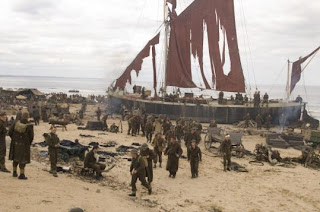
This is generally used to show the audience the setting of the film, providing them with extra information.
Continuity
Continuity refers to when there are visual errors. This is when things happen such as, a character is wearing Converse one moment, and then Vans the next.
Cutting (aka editing)
If it wasn't for this, films would be never ending, as they would be in real-life time. Because of editing, directors are able to change location when they need to. It is used to quicken or slow down the pace of a film.
Close-ups
Close-ups are when a character or object is closely framed. They are mainly used to make the audience focus on the character's facial expressions or an object's detail, but they are used for many reasons in television and film. Along with mid-shots and long-shots, this is the most regular shot used.
Composition
Composition is how props, characters and setting is placed and arranged to how they are needed to be.
Montage
A montage is when a long period of time is cut down so time passes quicker.
Here is an example of a montage, from one of my favourite films Stand By Me:
Some of the camera angles used to tell the story are:
- Close up
- Extreme close up
- Panoramic
- Mid-shot
- Long-shot
- Low angle shot
- Over the shoulder shot
- Point of view shot
- High angle

This is used to show some of the character's surroundings, interaction and their body language. When you're having a conversation, this would be the part of the person that you could see, so is seen as a "comfortable" shot.
An example of a long shot is:

This is generally used to show the audience the setting of the film, providing them with extra information.
Continuity
Continuity refers to when there are visual errors. This is when things happen such as, a character is wearing Converse one moment, and then Vans the next.
Cutting (aka editing)
If it wasn't for this, films would be never ending, as they would be in real-life time. Because of editing, directors are able to change location when they need to. It is used to quicken or slow down the pace of a film.
Close-ups
Close-ups are when a character or object is closely framed. They are mainly used to make the audience focus on the character's facial expressions or an object's detail, but they are used for many reasons in television and film. Along with mid-shots and long-shots, this is the most regular shot used.
Composition
Composition is how props, characters and setting is placed and arranged to how they are needed to be.
Montage
A montage is when a long period of time is cut down so time passes quicker.
Here is an example of a montage, from one of my favourite films Stand By Me:
Subscribe to:
Posts (Atom)